7.29.2026
Make the Rounds of Market Square!
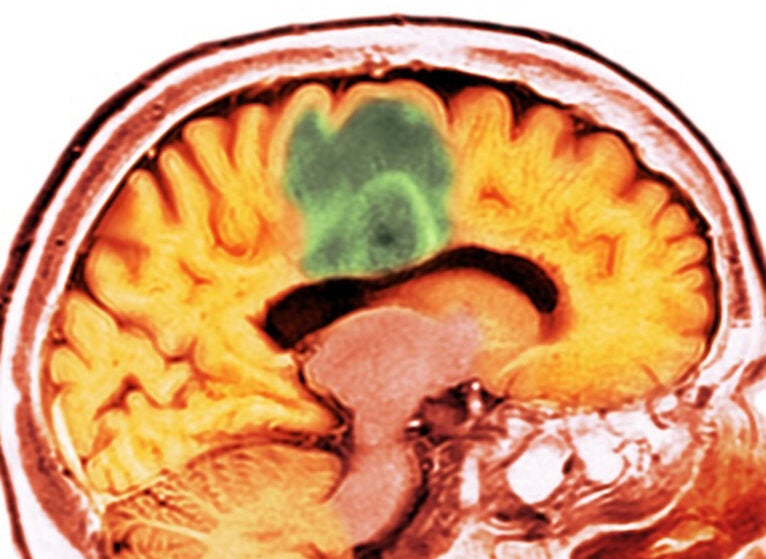
This colorized computed tomography (CT) scan shows a glioblastoma tumor — the most common and deadliest brain cancer. Gliomas are the most common primary brain tumors in adults. This group include glioblastomas,
In a promising sign for the potential of focused sound waves to improve care for brain tumors, UVA Health researchers have determined that tumors called gliomas may be even more receptive to targeted drug delivery than normal brain tissue.
While the research is still in its early stages, the findings help allay concerns that brain tumors might have properties that would make them stubbornly resistant to the cutting-edge approach. UVA scientists are using tiny “microbubbles” that are activated by sound waves to open the brain’s natural protective barrier, known as the “blood-brain barrier,” so that drugs can enter exactly where needed.
Inside brain tumors, cancer cells mutate the structure of the blood-brain barrier and its function becomes unpredictable. In turn, this raises questions about how effectively focused ultrasound can deliver therapies in the brain tumor environment and what sizes of drug molecules can be delivered most effectively. The new research from UVA Health’s Focused Ultrasound Cancer Immunotherapy Center provides important insights on both fronts.
“To address the central question, Dr. Wilson Miller worked with my graduate student, Matthew Hoch, to develop an MRI approach that would allow us to make drug-delivery measurements with unprecedented resolution. This approach had not been integrated with focused ultrasound before,” says researcher Richard J. Price, PhD, the center’s Co-director. “The outcome is exciting because it means that focused ultrasound delivery performance is not expected to diminish in brain tumors. In fact, it may even be enhanced for some types of therapeutics”
Better Brain Cancer Treatments
Gliomas are the most common primary brain tumors in adults. This group include glioblastomas, the deadliest form of brain cancer (illustrated above). While there are treatments that can extend survival and improve quality of life, glioblastomas are almost always fatal within 5 to 10 years, so new and better treatments are needed desperately. More than 10,000 people in the United States alone die from glioblastomas every year.
Part of the difficulty in treating glioblastoma is getting drugs through the brain’s natural defenses. The blood-brain barrier exists for an important reason: It keeps harmful germs and toxins out. So doctors have proceeded cautiously in trying to open the gates for fear of letting in dangerous invaders.
Focused ultrasound, however, is now letting doctors open the barrier extremely precisely and extremely briefly, so that beneficial drugs can slip inside unaccompanied by unwanted companions. Price’s approach would use low-frequency sound waves to send tiny drug molecules spinning directly into tumor cells. This is done without the need for cutting into the skull.
In addition to indicating that gliomas in lab mice are vulnerable to the approach, Price’s latest research sheds light on the sizes of molecules that would be most effective. He and his collaborators identified a “Goldilocks” size range where the molecules worked best. Very small molecules delivered the medicine less efficiently than larger ones, but very large molecules were less effective than the medium-sized ones. (This is relative, of course – all the molecules are far, far smaller than can be seen with the naked eye.)
The great promise of focused ultrasound to improve immunotherapy’s ability to treat cancer prompted UVA in 2022 to launch its Focused Ultrasound Cancer Immunotherapy Center – the world’s first center devoted specifically to that purpose.
Now UVA is bolstering its research tools with the addition of a cutting-edge MRI-guided focused ultrasound system for drug delivery to the brain. The system, by Insightec, comes equipped with an advanced magnetic-resonance imaging unit that provides astonishing views inside the brain. This will let the researchers better understand exactly what happens as they use sound waves to drive drug molecules into tumors.
“This new MRI-guided focused ultrasound system gives our researchers the ability to both deliver treatment and monitor its effects with exceptional precision,” said UVA Health’s James Stone, MD, PhD. “That combination will accelerate our understanding of how to optimize drug delivery for brain tumors and help move promising therapies closer to clinical care.”
“We have a deep commitment at UVA to advancing care for patients here and across the world through important research like this,” says Colin P. Derdeyn, MD, interim Dean, UVA School of Medicine. “We continue to be a leader in focused ultrasound research through the efforts of our outstanding investigators, federal funding for their work, and our collaborations with industry.”
While more research needs to be done, the promising results bode well for the efforts by UVA Cancer Center and UVA Paul and Diane Manning Institute of Biotechnology to develop new options for patients with brain cancers. (Manning Institute has been launched specifically to fast-track new treatments and cures for the most challenging diseases to benefit patients across Virginia and beyond.)
“I am hopeful this research illustrates how advanced MR imaging methods can be used to improve focused ultrasound delivery treatments in the clinic,” Price says. “In particular, it’s exciting to think about how these technologies could be combined with future gene therapies, from Manning Institute investigators and companies, aimed at treating brain tumors.”
Findings Published
Price and his collaborators have published their results in the scientific journal Radiology. The research team consisted of Matthew R. Hoch, Victoria R. Breza, G. Wilson Miller, and Price, who is part of UVA Department of Biomedical Engineering, a joint program of UVA School of Medicine and UVA School of Engineering and Applied Science, as well as part of the UVA School of Medicine Department of Radiology and Medical Imaging.
UVA’s research was supported by the National Institutes of Health, grants R01EB030409, R01EB030744, R21NS118278, and R01CA226899, and by the UVA Focused Ultrasound Cancer Immunotherapy Center.
To keep up with the latest medical research news from UVA, subscribe to the Making of Medicine blog.