9.2.2026
UVA Health Update | Sept. 2, 2026
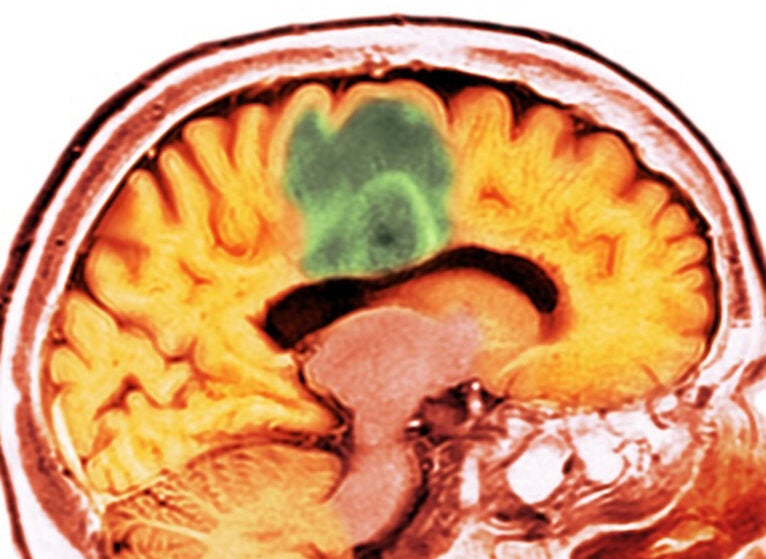
This colorized computed tomography (CT) scan shows a glioblastoma tumor — the most common and deadliest brain cancer. Gliomas are the most common primary brain tumors in adults. This group include glioblastomas.
UVA Comprehensive Cancer Center scientists have uncovered a crucial role for calcium channels in glioblastoma, the most common and deadliest brain cancer, suggesting that an existing calcium-blocking drug could improve patient outcomes.
UVA’s Roger Abounader, MD, PhD, and colleagues found that calcium-transporting channels in tumor cells and surrounding nerve cells play vital roles in promoting glioblastoma’s growth. Blocking the flow of calcium through these channels in lab mice slowed tumor formation and let the animals live longer.
Further, the results indicate that combining the FDA-approved calcium-blocking drug mibefradil with existing treatments could make the tumor cells easier to kill, the scientists say.
“Blocking the T-Type calcium channels acts both on the tumor cells and on connections of the tumors with surrounding nerve cells, which promote tumor growth. Because of that double effect, blocking these calcium channels is very efficacious in slowing down glioblastoma growth,” says Dr. Abounader, UVA School of Medicine, UVA Comprehensive Cancer Center, and UVA Center for RNA Science and Medicine. “Because mibefradil is FDA-approved, it could be rapidly tested in clinical trials for newly diagnosed glioblastoma patients.”
More Effective Glioblastoma Treatment
Glioblastoma kills more than 13,000 American adults every year — most within two years of diagnosis. It is an extremely difficult cancer to treat, as it aggressively threads itself through the brain. Full surgical removal is impossible, so doctors remove as much as they can, then use radiation and chemotherapy to extend patient survival.
Blocking calcium in the tumors and surrounding nerve cells could both slow the cancer’s growth and make the cancerous cells easier to kill, Dr. Abounader’s research suggests. He and his collaborators found that calcium played important roles both in the cancer cells and in the surrounding “microenvironment.” The flow of the calcium helped the tumor cells form connections with nerve cells called neurons which are known to promote tumor growth. Shutting off the flow of calcium put the tumors at a major disadvantage and slowed their growth.
The results suggest that mibefradil or a similar calcium-blocking drug could slow the progression of glioblastoma and sensitize the cancer cells to radiation and chemotherapy. Mibefradil has been approved by the federal Food and Drug Administration for treating high blood pressure, but it was voluntarily withdrawn by its manufacturer because of potential interactions with drugs used for treating heart disease. That means doctors would need to avoid giving those drugs together.
“To conduct clinical trials, clinical-grade mibefradil would have to be manufactured,” notes Dr. Abounader, UVA Department of Microbiology, Immunology, and Cancer Biology. “The clinical drug manufacture is very expensive, and we are searching for funding sources in order to be able to do it.”
In addition to their calcium research, Dr. Abounader and collaborators at UVA are developing a new approach to treating glioblastoma using microRNAs in combination with nanoparticles, focused ultrasound and microbubbles.
Finding new ways to improve cancer care is a core mission of both UVA Comprehensive Cancer Center and UVA Paul and Diane Manning Institute of Biotechnology. UVA Comprehensive Cancer Center is one of just 57 cancer centers in the nation to earn the “comprehensive” designation from the National Cancer Institute. The prestigious accolade recognizes elite centers that offer both exceptional patient care and cutting-edge cancer research.
Manning Institute, meanwhile, aims to accelerate the development of new drugs and treatments for the most complex and challenging diseases. This is being complemented by a statewide clinical trials network that expands access to potential new treatments as they are developed and tested.
Findings Published
Dr. Abounader and his colleagues have published their findings in the scientific journal Neuro-Oncology. The research team consisted of Collin J. Dube, Ying Zhang, Shekhar Saha, Tyler C.J. Deutsch, Matthew Yorek, Michelle Lai, Myron K. Gibert, Miguel Escalante, Kadie Hudson, Doris Wong, Pawel Marcinkiewicz, Ulas Yener, Yunan Sun, Esther Xu, Aditya Sorot, Elizabeth Mulcahy, Benjamin Kefas, Farina Hanif, Fadilla Guessous, Ashley Vernon, David Schiff, Hui Zong, Benjamin Purow, Eric Holland, Swapnil Sonkusare, Harald Sontheimer, Manoj K. Patel and Dr. Abounader. The scientists have no financial interest in the research.
The work was supported by the National Institutes of Health’s National Institutes of Neurological Disorders and Stroke, grants R01 NS122222 and 1R21NS122136; NIH grants R01 NS122834 and NIH R01 NS120702;
National Cancer Institute grants U01 CA220841 and 5T32CA009109-47; NCI Cancer Center support grant P30CA044579; a UVA Comprehensive Cancer Center pilot grant; a Schiff Foundation grant; and a Parson Weber Parsons Fellowship.
To keep up with the latest medical research news from UVA and the Manning Institute, bookmark the Making of Medicine blog.