
9.15.2026video
Video | Hope at Work: UVA Health Physician Becomes a Patient for ‘A Second Chance at Life’
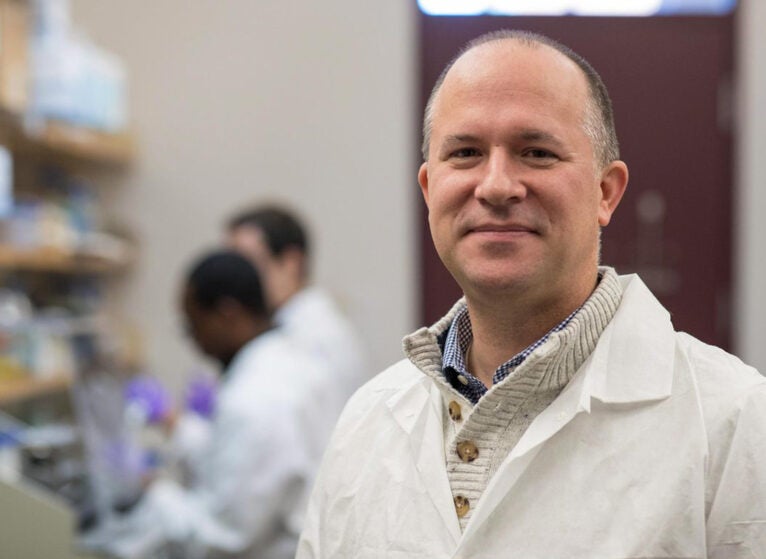
Jason Papin, PhD, UVA School of Medicine
UVA researchers have received the first $4 million tranche of an award worth up to $12 million from the National Institutes of Health (NIH) to develop a digital model showing how hormonal differences between men and women can impact the effectiveness of some medications.
Hormone activity varies between men and women, and scientists don’t have enough data to evaluate how sex hormones influence how well drugs work across different groups of patients.
To bridge that gap, UVA researchers will use the NIH award to develop a large, open-source tool called MOSAIC (Modeling of Sex-specific metabolism Across Interacting Communities). One of MOSAIC's key aims is to simulate how women's gut, liver, and reproductive systems work together and how gut bacteria can affect estrogen levels.
“Computational models in biomedicine are catalyzing new discoveries and generating remarkable therapeutic strategies,” says Jason Papin, PhD, the lead proposer of the new computational model. “With MOSAIC, we hope to create a computational tool that can lead to personalized predictions, accounting for complex hormone dynamics among other physiological processes.”
Papin is a professor at UVA Department of Biomedical Engineering — a joint effort of UVA School of Medicine and UVA School of Engineering and Applied Science — and will serve as the project’s principal investigator. Other UVA leaders on the project include Shayn Peirce-Cottler, PhD, Isabelle Derre, PhD, Monique Vaughan, MD, and Glynis Kolling, PhD.
The researchers will use innovative, artificial intelligence-assisted tools to: organize large datasets; combine different types of biological data to create a unified picture; and build digital models that reflect how male and female bodies process drugs differently.
UVA scientists plan to test the tool on two health conditions that are unique to or disproportionately affect women: bacterial vaginosis (BV) and metabolic dysfunction-associated steatotic liver disease (MASLD), formerly known as non-alcoholic fatty liver disease.
BV is the most common vaginal condition in women ages 15-44 and is estimated to affect nearly 29% of women in the United States. MASLD affects both men and women, but a recent study found that polycystic ovary syndrome (PCOS) and menopause can nearly double a woman’s chances of developing MASLD.
By testing MOSAIC on BV and MASLD, UVA researchers hope to create the first digital model that can predict how well a drug will work, examine its possible side effects, and speed the development of more targeted drug therapies. Developing drugs more quickly is an important goal of the new UVA Paul and Diane Manning Institute of Biotechnology, which has been launched to accelerate lab discoveries into medicines to benefit patients across Virginia and beyond. “This new funding from the NIH will be a catalyst for enhancing the biotechnology capabilities of our area,” says Papin.
The award, 1OT2OD042817, is part of NIH's Computational Modeling of Hormone Homeostasis Initiative. The campaign is a joint effort by NIH Office of Research on Women’s Health — and Division of Program Coordination, Planning, and Strategic Initiatives — to use large, data-driven models to broaden understanding of sex-specific hormonal biology. NIH’s newly established Office of Research Innovation, Validation, and Application provided more than $4 million in co-funding for this project. Researchers from Johns Hopkins University, University of Connecticut, University of Michigan, and University of Illinois Chicago also will be involved in the project.
To keep up with the latest medical research news from UVA and the Manning Institute, bookmark the Making of Medicine blog.