11.3.2026
‘Pop Up in Pink’ Puts ‘Boots on the Ground’ Around Charlottesville During Breast Cancer Awareness Month
For more than four decades, Reid Adams, MD, has been a devoted member of the UVA community. Through every stage of his journey here — as an undergrad, medical student, physician, mentor and leader — Dr. Adams has been driven by a desire to serve or, in his words, “to leave the people, the places and the institutions entrusted to us better than we found them.”
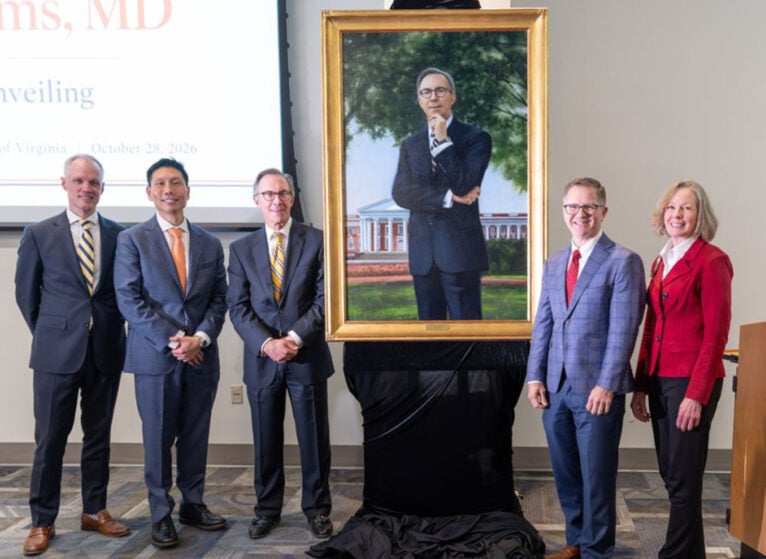
On Wednesday, Oct. 28, Dr. Adams was recognized for doing just that at a ceremony marking a longstanding Department of Surgery tradition: the unveiling of the chair’s portrait. Dr. Adams served as department chair until 2022 and has had many leadership roles over the course of his career, including his most recent appointment as the inaugural Chief System Medical Officer.
In the Q&A below, Dr. Adams reflects on his time at UVA, the lessons and people who helped shape his career, and the many reasons he’s happy to call Charlottesville home.
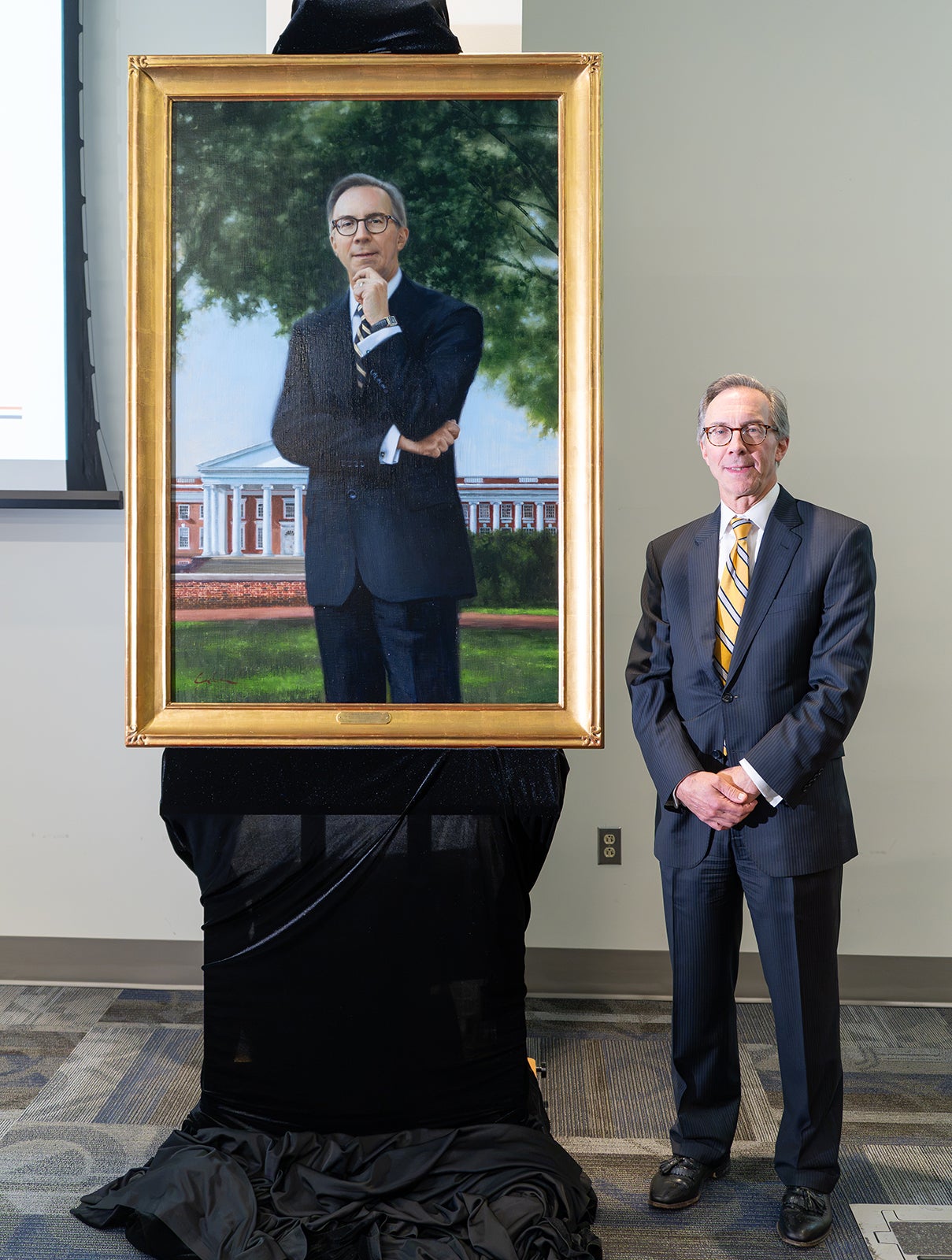
Congratulations on your recognition. How did it feel to be honored in this way?
Adams: It was a lovely evening. Everyone was incredibly kind and generous, and I’m grateful that so many joined us in celebrating a longstanding tradition in the Department of Surgery, now going on 100 years. However, it was a little uncomfortable for me as I’ve always preferred working quietly alongside others rather than being in the spotlight.
What did you think about your portrait?
Adams: Having never sat for a portrait, I had no idea what to expect. What surprised me most was the extraordinary time and care [Jonathan Linton] devoted to understanding me as a person — not simply capturing a likeness, but trying to convey something of the individual behind it. Through our conversations, I came to appreciate his creativity, patience, and thoughtfulness as a true master of his craft.
You’ve been part of the UVA community since 1979. What is it about UVA that is special to you and has kept you here for all these years?
Adams: It's really about the people. People who are incredibly passionate about the mission. People who are great colleagues, incredibly collegial and collaborative, and who have made it really easy to stay and want to be part of the collective that's working towards the common goals of caring for patients, educating all of our learners, and doing discovery work to try to advance the field of medicine. And, I have been fortunate to have had so many opportunities to grow in the profession and contribute to the organization.
I also really like being in a college community with the ebb and flow of academic life. There’s a lot of new activity with students returning in the fall, and then after graduation, a return to a more calm summer with a different pace of life. It provides different opportunities for those of us that live in Charlottesville who are really engaged in the university and all its events. Finally, we love the outdoors, and you can’t ask for a more beautiful place with so many things to do in that respect.
Was becoming a surgeon always your plan?
Adams: Well, that’s a good question. Kind of. I had to work during college to help pay my way, and one of my jobs was being an orderly in the emergency room for three years as an undergraduate. That was a period of time where I began to think that surgery might be the right thing for me. Then I went to medical school, and I loved nearly all the specialties, so I thought about many other options rather than surgery. It wasn't until fourth year, when you have to make a decision, that I came back to surgery and it has been a wonderful choice.
What do you find most rewarding about being a surgeon?
Adams: There is a direct and often immediate connection between the care you deliver and the sense of being able to accomplish something so impactful for a patient. I really enjoy the thought that goes into the diagnosis and decision-making, and the highly technical aspects of surgery. The combination is what attracted me and it is very results-focused work. You can see the product of all the time and effort that you spent getting educated, developing a skill and then applying it to dramatically impact and improve people's lives.
Did you have any mentors during your training or later in your career who made an impact on your practice or your leadership?
Adams: A lot! Way too many to list. But probably the most impactful were Scott Jones, who was the chair of surgery. He took me under his wing as an undergraduate. I worked in his lab, and he really mentored me along the way, and then fortunately decided that I could contribute and hired me on faculty.
John Hanks and Bruce Schirmer have been extraordinary mentors, trusted advisors, and dear friends. In addition to the daily wisdom they shared and which helped me grow, I had the good fortune to serve in a number of national positions, and much of that had to do with the mentorship and sponsorship of both of those individuals.
Additionally, there are so many other people at UVA Health that saw something in me and believed in me who gave me opportunities outside the Department of Surgery, whether it was leading the oncology service line or the CMO role, both for University Medical Center and then for the health system.
What accomplishments are you most proud of?
Adams: I think what I'm most proud of are two programs that I helped to build over the years, programs that didn't exist at the time: the GI Oncology Program, and the Hepatobiliary Surgery Program. Another was helping build out the Cancer Center to allow it to continue to grow to what it is today. The Chair of Surgery was a really important and impactful role, giving me the opportunity to mentor an incredible number of students, residents, and colleagues, with the idea that they would also develop in their professional careers, in their leadership interests, and themselves be able to contribute to the organization.
You had two key leadership positions — University Medical Center CMO and Surgery Department Chair — at the same time during COVID. What did leading during that challenging time teach you about yourself and your colleagues?
Adams: Leading in a crisis is not something that I would wish on anyone, yet it was incredibly beneficial to me in terms of developing new skills as a leader. It’s very different from leading when you have time to think about and develop strategy, work to improve operations and to do so in a prospective, measured way. I think the thing that was most illustrative about COVID and some of the good things that came out of it was, as an organization, we learned that we can pivot quickly and adapt to rapidly changing circumstances, something that we weren’t sure we were capable of prior to COVID. We tend to be deliberate in our decision making, and we couldn't do that during COVID.
It was amazing to see an incredible number of people working together, all in creative ways to solve problems that we hadn't encountered before, and doing things on a dime — in a day or a week — that would take us months to do prior to COVID. We also learned we could expand our ability to deliver care outside of a physical setting. Virtual care is now pretty standard, but we didn't think that was really possible or desirable at the time, and so I think those are two of the big lessons that came out of COVID.
As the inaugural system CMO, you are the “senior physician.” What does this title mean to you?
Adams: The role is about trying to help us continue on the journey to integration. If you're a patient or family and you enter our system anywhere, whether it's the emergency department, a clinic, community health, or any of our offices, you should have an experience and an outcome that’s consistent across all locations. We want to give outstanding, patient-centered care so that, as a patient or family member, you are confident you are getting the highest quality care at any place when you interface with a UVA facility. I think, for me, that's really what the role is about: How do we develop that integration so that it is as seamless as possible for our patients to get the care that they need closest to home? Then from our team member’s perspective, we want to allow them to do their job as easily as possible with the confidence that they’re delivering excellent care, and when they hand off a patient somewhere else in the system, they know patients will get the same high-quality care that they provide.
What are the most significant changes that have happened in your time at UVA that you feel have impacted patient care?
Adams: That’s a long timeframe! I think the most important thing is that we've continued to hire and retain outstanding clinicians and team members of all skills who are trying to provide the best care that they can. Also, trying to develop programs that really provide seamless care amongst all patient populations. There are lots of good examples, whether it's the children's hospital and trying to build programs around all children's needs; or the oncology program, giving care in a single site of service to make it as easy for patients to get care as effortlessly as possible. What’s important is our ability to continue to adapt and evolve so that we can take care of all the people that seek it from us.
What advice do you have for future surgeons?
Adams: Lean into what you're passionate about. Spend the necessary time and energy to become an expert at whatever type of care you're delivering. Do so with compassion, and those things will lead to good outcomes for both your patients and then for yourself in terms of opportunities for professional growth and development.
When you’re not busy with work, what do you enjoy doing?
Adams: My wife and I love to travel, especially to see our daughter. My other fun passion is fly fishing. We have friends that have a place in Montana. We go visit them every year for a couple weeks, and so that has become a favorite spot because there's solitude, a time to restore, and a lot of great fishing. We are fortunate as we live in the western part of the county, so I love the peacefulness and beauty when fishing close to home up in Sugar Hollow.
What role has your family played in supporting you throughout your career?
Adams: The most important. I couldn't do it without them. My wife, Michelle, has been incredibly supportive, and a trusted advisor. So it wouldn't happen without her.
Are you an animal lover?
Adams: Yes, we have cats. My wife used to do rescues, so we used to have a lot of cats for a while; now we are down to two. We’re also fortunate that we have a wide range of wildlife out in the county, and that's always enjoyable to see the variety of things that live within the Charlottesville area.
Do you have a favorite local restaurant?
Adams: Yes, plural. We love to go to Tavola, Ten, Fleurie, Palladio up in Barboursville, and so many more. Charlottesville and its surroundings have so many fabulous places to dine. My wife will tell you that I pretty much eat anything. In particular, I enjoy chefs' tasting menus because it's always different, it's unexpected, and typically terrifically good. So it's an opportunity to explore something different that you wouldn't just order off the menu.
What are you bingeing on TV at the moment?
Adams: We watch a wide variety of things, but I would say probably a combination of crime dramas and documentaries about nature and travel.
Are you a fan of The Pitt?
Adams: I was probably ruined long ago watching a few episodes of ER or Grey's Anatomy or something similar. It’s just, when you live it every day, you don't want to live it in your off time, and then it isn't necessarily that accurate. So, no, but I have not watched The Pitt specifically.