3.24.2026
Need to Know | University Medical Center
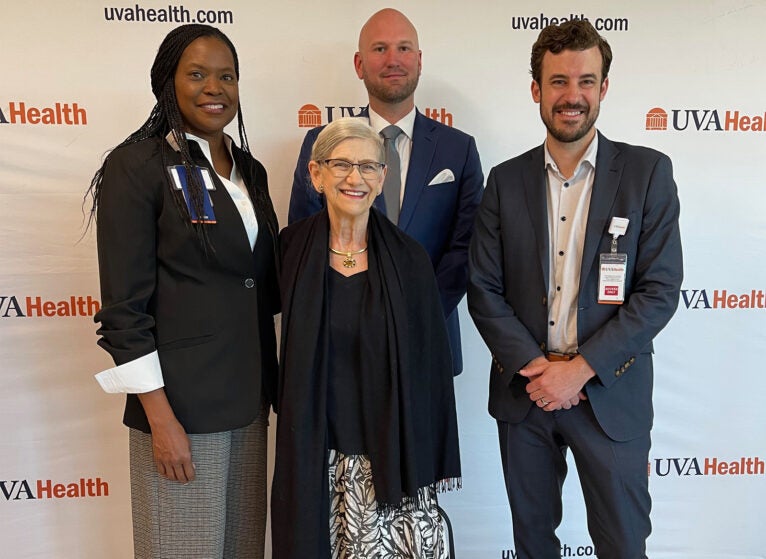
From left: Rozlyn Giddens, Program Manager, Community Engagement, UVA Community Health; Pat Victorson, President, NAMI Prince William (front); Ross Snare, Associate Chief, External Affairs, UVA Health (back); and Mike Barkema, Assistant Vice President, Operations, UVA Health Prince William Medical Center.
During the 2025 grant cycle, UVA Health awarded more than $297,000 to 38 nonprofit organizations across Northern Virginia and Culpeper, aligning with our strategic plan by supporting our most vulnerable populations. Grant awardees are partners who provide resources that address identified needs within the communities we serve.
One of these awardees, National Alliance on Mental Illness (NAMI) of Prince William, offers support, education, and advocacy designed to help those with mental illnesses and their families. Because of their work in promoting non-discriminatory access to quality healthcare, housing, education, and employment for people with mental illness, they received a $25,000 Community Strong grant. “This grant is really making a difference for our programs," says NAMI Prince William President Pat Victorson.
Supporting the Mental Health of Young and Marginalized Communities
These grant funds were used to implement programs with a focus on youth and families, to promote mental health awareness in underserved populations, and to expand mental health support and education programs. Specific funds were allocated to the four existing and one new NAMI on Campus (NOC) High School Clubs with approximately 175 active members, providing resources such as stress-relief materials, mental health support for student athletes, mental health guides and brochures, and presentations focused on promoting social and emotional wellness.
Victorson notes, “The enthusiasm of NOC club members at our five participating schools is infectious. Students are eager to share the impact their clubs are having not only on their peers, but on the overall culture of their schools. Through student-led, peer-to-peer initiatives, club members are normalizing conversations about mental health, reducing stigma, and creating visible pathways to support.”
The funding also allowed them to provide a series of 13 community information sessions, with more planned across churches, clubs, senior centers, and other organizations focused on crisis and recovery support. Additionally, NAMI used the grant funds to support underserved communities outlined in our Community Health Needs Assessment.
Victorson explains, “We trained three facilitators in ‘Sharing Hope’ for the Black/African Ancestry community and six facilitators for ‘Compartiendo Esperanza’ for the Latino community, and we held six community awareness sessions about mental health in Spanish with partners at CASA and Georgetown South Community Center. Funds were used for training, stipends, supplies, refreshments, and gift-card incentives.”
Helping Students Make a Difference On and Off Campus
The NOC clubs that the grant has helped support already have had a strong impact on students and their surrounding communities. These clubs have shown up at athletic events to distribute more than 200 gift bags including fidgets, “You Are Not Alone” bracelets, socks, and mental health information. They meet students where they are and reinforce that support is available in everyday spaces. Lunchtime tables offer approachable entry points to mental health awareness through interactive activities encouraging students to “let their worries fall away” during school breaks.
Other efforts center on creative programming such as music-based emotional exploration and playlist activities that allow students to express emotions, reflect on challenges, and practice healthy coping strategies. Building on this creativity, other club members have filmed gratitude videos to thank teachers and staff for their positive influence, strengthening connection and belonging across the school community.
Club efforts bolstered by the grant funds also have extended outside schools. For example, service projects, such as delivering 159 pairs of warm socks to the Hilda Barg Homeless Shelter, helped students translate empathy into action. Additionally, officers from the Freedom High School NAMI on Campus Club also attended the opening of the Crisis Receiving Center, deepening their understanding of local crisis response resources.
“Across schools, students consistently describe NAMI on Campus as a safe space that fosters belonging, empowers youth leadership, and encourages help-seeking.” Victorson describes. “As one student writes, ‘We want to create positive changes on campus and provide safe spaces where students can be understood.' These efforts reflect the heart of NAMI’s mission: empowering young people to support one another and build more compassionate, mentally healthy school communities.”
This mission complements UVA Health’s mission of transforming health and inspiring hope for all Virginians and beyond.