12.5.2025
Compassion, Persistence, Advocacy: UVA Community Health BEE Award Winner Reunites a Family
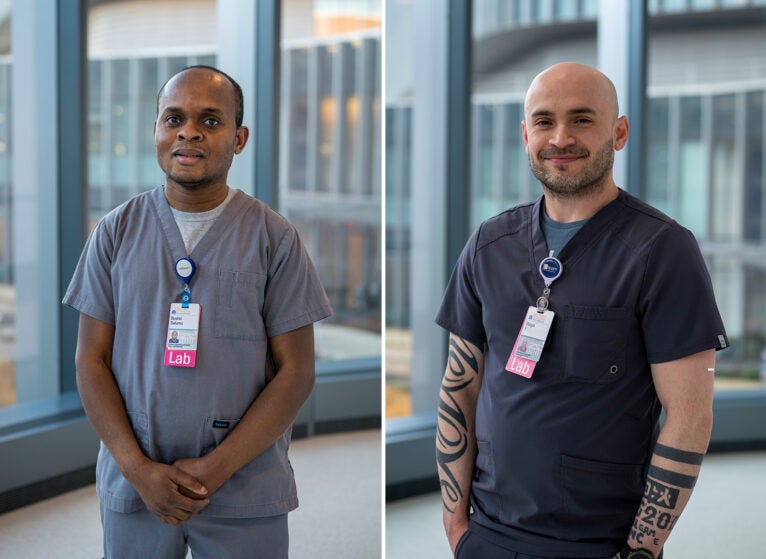
(l-r: Bushiri Salumu and Biagio Fittipaldi)
One of the many key pieces of the patient care puzzle, our Clinical Laboratory staff help create the framework that allows us to build a picture of what’s going on inside of the body. Their work is essential — around 70% of all medical decisions are informed by results generated by the lab. Yet often, these important roles are overlooked, particularly among those aspiring to enter the healthcare field.
Through our Medical Laboratories Education Program, UVA Health is working to raise awareness about the many rewarding opportunities in the lab and help those pursuing a career in laboratory medicine find success.
“I do a lot of outreach to local high schools and colleges to let students know about the profession because we’re behind the scenes and these positions aren’t as widely recognized as patient-facing roles,” says Medical Laboratories Education Coordinator Briana Shelton, MLS, SH. “Also, just like nursing, most of the jobs within the medical labs require a clinical internship, so we work with schools across Virginia to bring students in for those and turn them into employees.”
There are multiple pathways a student can take to pursue a career in laboratory medicine. For example:
UVA Health partners with universities across the state to provide students with lab exposure and experience through clinical internships. “We've hired about 50 students over the past five years that have had clinical rotations here, with about 37 of them being retained,” says Shelton. “That’s a very high number of hires, and the retention rate is really very good.”
High retention rates may be attributed, in part, to the many opportunities UVA Health provides entry-level lab staff to grow in their careers. This includes:
Career growth often is not a straight line. Rare are those who enter college or even their first job with a definite path in mind. Interests change, opportunities arise and life happens, taking you down a different road than you originally planned. Two of our lab staff found success at UVA Health by following their passion, working hard and taking advantage of resources made available to them.
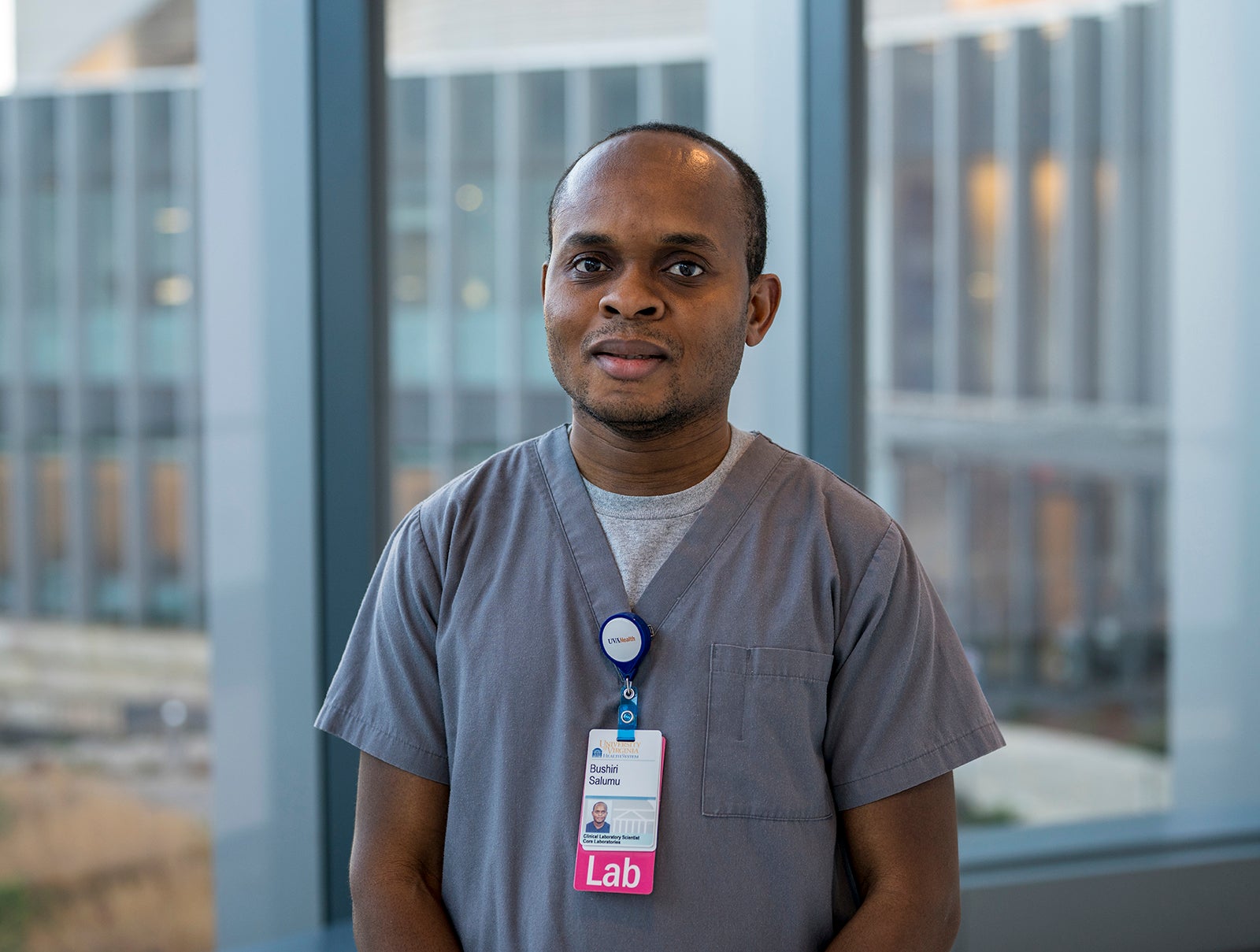
Bushiri Salumu was born in the Congo, where at age 17, he faced civil war, the loss of his parents and siblings, torture, and trauma that stole his childhood and took his voice. College and career were distant hopes as he focused on surviving life in a refugee camp. Fortunately, Salumu was chosen for resettlement in the U.S. and Charlottesville became his new home. He not only regained his ability to speak, he also learned English, and eventually obtained his GED.
“My father was a physician, and my mother was a teacher with a degree in chemistry. From a young age, I dreamed of studying medicine. I shifted my original dream of becoming a physician toward healthcare roles such as medical laboratory technology and nursing. To explore both pathways, I enrolled in certified nursing assistant [CNA] and phlebotomy programs at Piedmont Virginia Community College [PVCC],” says Salumu. “After earning both certifications, I worked as a CNA in the UVA NICU from 2019 to 2020, and later as a phlebotomist from 2021 to 2025. During that time, I visited the Core Lab and spoke with several technologists and scientists, which deepened my appreciation for laboratory medicine and ultimately inspired me to pursue the medical laboratory technology program.”
Today, Salumu works as a Clinical Laboratory Scientist 1 (CLS1) in the Core Lab, performing high-complexity diagnostic testing in chemistry and hematology. In addition to his own incredible dedication in the face of adversity, he says that the support he received from the Medical Laboratories Education Program and his colleagues in the lab were key to his success.
“UVA’s educational benefits supported me financially from the beginning of the MLT program and made it possible for me to complete my training. In addition, I received a work-grant scholarship through UVA Laboratories, which guaranteed that a position would be waiting for me upon completion of my program, an opportunity for which I am truly thankful,” he says. “In addition, all three of my PVCC MLT instructors were UVA employees who guided me throughout my training. Their mentorship played a major role in shaping my career path.”
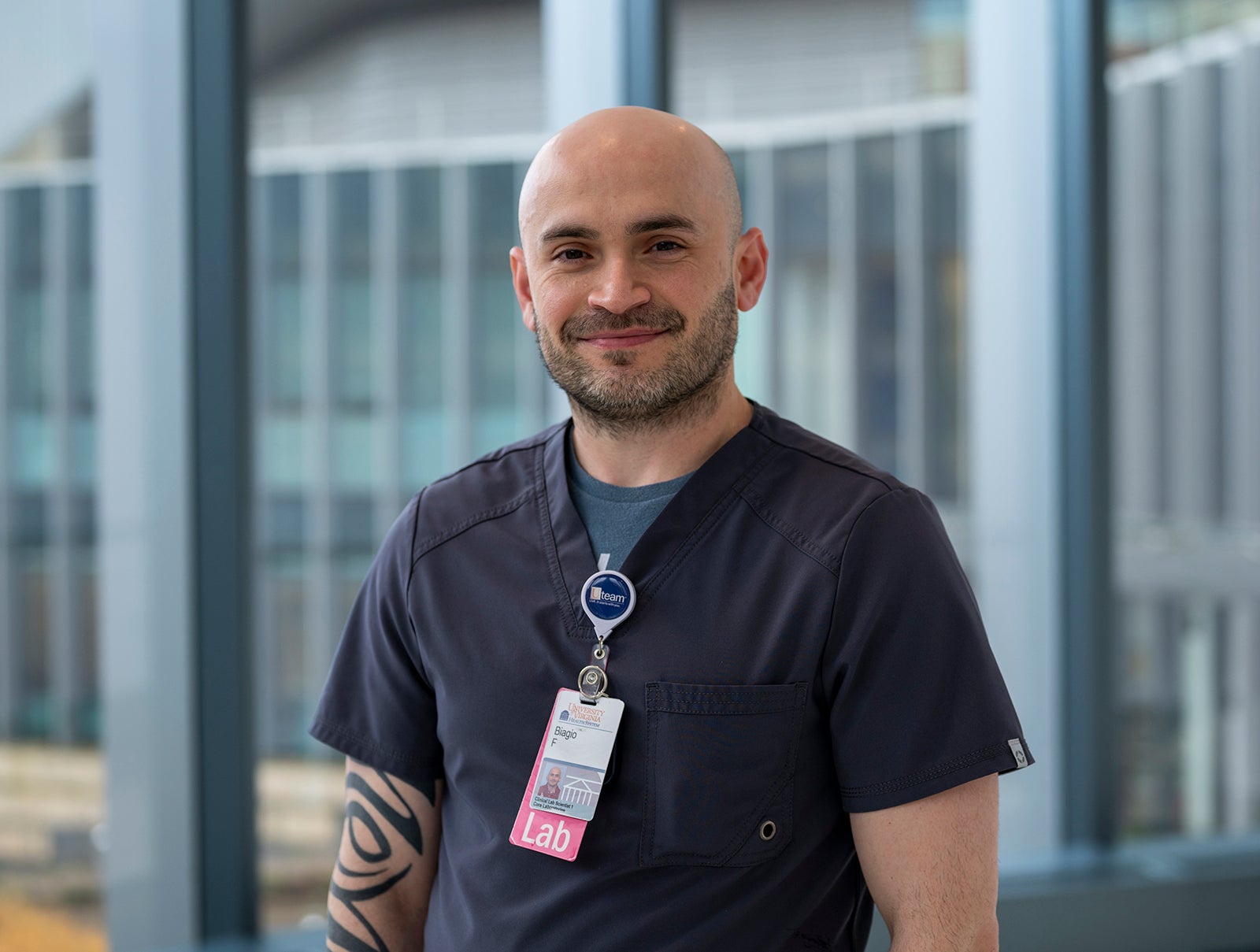
Like many people, Biagio Fittipaldi knew he wanted to work in the healthcare field, but he wasn’t sure in what capacity. “It's been a journey since I started at UVA. I started from the bottom. I was a transporter at the beginning. I did that for around three-and-a-half years, and then I moved into the OR, working the night shift as an anesthesia tech,” he says. “It was interesting, but I wanted something where I could grow professionally.”
Fittipaldi was attending PVCC at the time, and his advisor informed him about the laboratory medicine program. “She asked me about nursing, but that’s not really my thing,” says Fittipaldi. “But the lab program sounded interesting because I really enjoyed microbiology.”
Fittipaldi applied for the MLT program, and he got in. One of his professors was Shelton, who told Fittipaldi about the Medical Lab Assistant position in the UVA Core Lab that would allow him to work in the lab while finishing his coursework. “I began working in the Core Lab as an MLA, so I got to know the lab, the people, which was the best choice,” he says.
With a scholarship and educational assistance from UVA, Fittipaldi has been able to continue advancing his training and moving up the career ladder. He graduated from PVCC with an associate’s degree and is now pursuing his MLS degree through an online bridge program at the University of Arkansas for Medical Sciences.
“I study in the morning, and then I work the evening shift as a CLS1,” he says. “When you’re working, you’re basically doing clinicals. I am doing all the lab testing — the urine sample testing, differentials on red blood cells, white blood cells — which helps me a lot with my courses.”
Upon finishing the MLS program, Fittipaldi says he’s confident he’ll find job fulfillment in the lab. He will advance to a CLS2, and from there, he can explore further specialization or lab management. “The great thing is you have options,” he says. “At UVA, they have specialty areas like toxicology, bone marrow testing, and immunochemistry. There’s always something new.”