
1.28.2026
UVA Health Update | Jan. 28, 2026
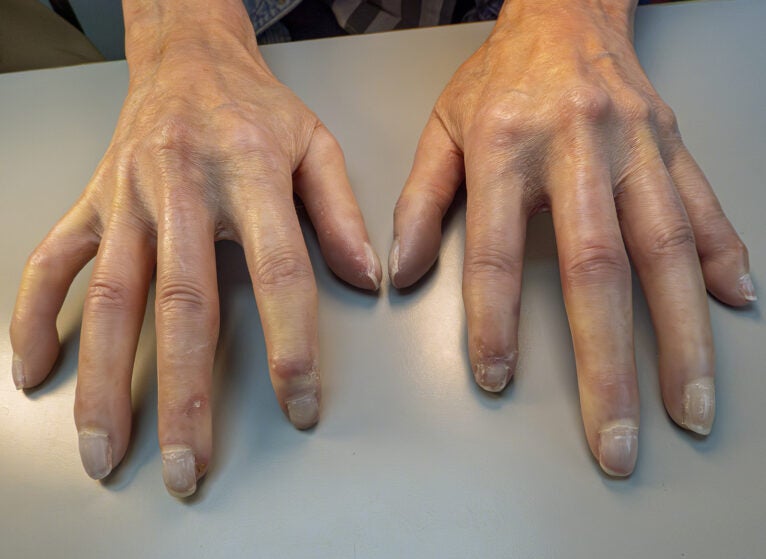
Patient's hands with scleroderma. Getty image.
Scientists may be able to develop ways to prevent the potentially deadly hardening of skin and organs caused by systemic scleroderma by targeting particular immune cells, new findings from UVA School of Medicine suggest.
Research led by postdoctoral researcher Blandine Baffert in the lab of UVA Health’s Sanja Arandjelovic, PhD, in collaboration with Sylvain Perruche, PhD, in Besançon, France, determined that immune cells called macrophages are directly responsible for the buildup of fibrous scar tissue seen in systemic scleroderma. The autoimmune disorder kills more than 30% of patients within 10 years, often because of scarring in the lungs.
There are no treatments that can prevent tissue and organ hardening in patients with systemic scleroderma. But Baffert, Arandjelovic, and their collaborators were able to halt this scarring in lab mice by targeting macrophages. Their results suggest a promising new approach that one day could lead to a much-needed treatment for systemic scleroderma and potentially for other forms of scarring caused by chronic inflammation, the scientists say.
“These data suggest that a single cell type, macrophage, may be responsible for inducing scleroderma,” says Arandjelovic, UVA Division of Nephrology and UVA Center for Immunity, Inflammation, and Regenerative Medicine. “Alhough more research is needed on understanding whether targeting these cells later during disease progression can reverse the existing tissue damage, our data suggest that macrophage inhibition could be effective in disease prevention in the high-risk patient population.”
Understanding Systemic Scleroderma
Systemic scleroderma typically affects women more often than men, and it usually first strikes between ages 30 and 50. People of African and Choctaw Native American descent are at particularly high risk. It’s estimated that approximately 100,000 Americans have the condition, while an additional 200,000 have a form of scleroderma that affects more localized parts of the body and poses much less risk of death.
The hardening of tissue and organs seen in scleroderma is caused by an excessive buildup of collagen, an important building block of our skin, bones and connective tissue. This collagen buildup, Arandjelovic found, is driven by macrophages responding to inflammation. Normally, macrophages stand down once inflammation resolves, but in systemic scleroderma, the inflammation never ends. So the macrophages continue to spur the production of collagen until it ultimately becomes damaging, she and her team determined.
Encouragingly, the researchers reduced macrophage activity in their lab models using two different approaches and found that both completely prevented harmful fibrosis.
Based on the results, the scientists believe they may be able to develop a treatment for systemic scleroderma by preventing macrophage buildup or by targeting the substances macrophages produce that fuel collagen production.
“Clinically approved therapies that target macrophages already exist,” Arandjelovic says. “Repurposing these treatments for use in scleroderma would be an exciting next step in finding new therapies for this devastating disease.”
Finding treatments for untreatable diseases is a major mission of the new UVA Paul and Diane Manning Institute of Biotechnology. The institute aims to accelerate how quickly lab discoveries can be turned into new treatments and cures.
Findings Published
Arandjelovic and her team have detailed their findings in the American Journal of Pathology. The team consisted of Blandine Baffert, Kevin Schneider, Audrey Wetzel, Ludivine Dal Zuffo, Cecile Chague, Elea Mitifiot, Francis Bonnefoy, Alicja Kuzniewska, Philippe Saas, Jamal Bamoulid, Gwenael Rolin, Sylvain Perruche, and Arandjelovic.
To keep up with the latest medical research news from UVA, subscribe to the Making of Medicine blog