5.4.2026
UVA Health Update | May 4, 2026
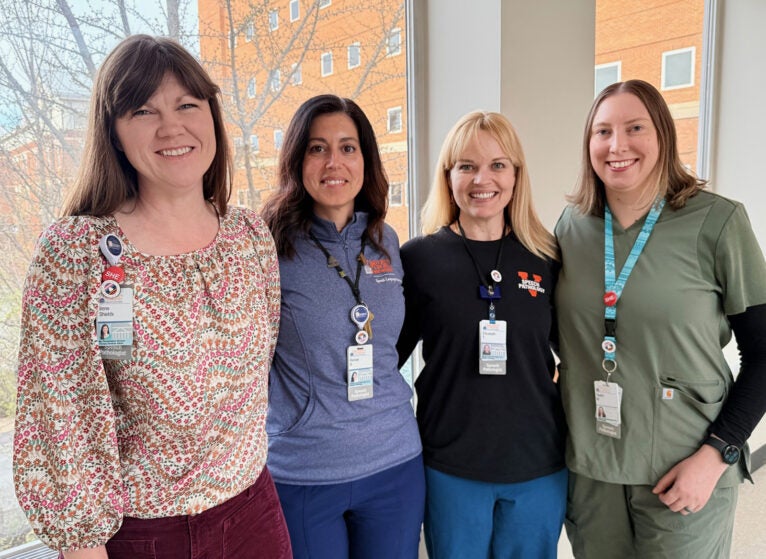
From left: Irene Shields, MA, CCC-SLP; Renee Bricker, MS, CCC-SLP; Elizabeth Turner, MS, CCC-SLP; and Taylor Meyer, MS, CCC-SLP.
May is National Speech-Language-Hearing Month. For Intensive Care Unit (ICU) patients, losing the ability to speak can be devastating — affecting care and wellbeing. At UVA Health University Medical Center, speech-language pathologists (SLPs) are dedicated to restoring communication for patients silenced by ventilators or illness. By implementing innovative solutions and collaborating with care teams — they empower patients to express pain, make important decisions, and connect with loved ones when it matters most.
More Than Swallowing: Meeting Patients’ Needs
Many people associate SLPs with swallowing needs. But Irene Shields, MA, CCC-SLP, Manager, Speech-Language Pathology, says her team supports patients with a wide range of needs across numerous units including Neurology, Thoracic and Cardiac Surgery, ENT, and Trauma, especially those in the ICU requiring respiratory support. “Many patients recovering from surgery and needing respiratory support require help with communication," explains Shields.
Adds Lara Demers, PT, DPT, BCHE, Director, Adult Rehabilitation Services, adds, “The team is rising to meet the diverse needs of all of our patients.”
High-Tech Solutions for Complex Needs
The SLP team works closely with Respiratory Therapy to help ventilated patients use in-line speaking valves. These devices are placed in a breathing tube to allow air to flow past the vocal cords so speech is possible. “These devices help patients express pain, describe symptoms, and take part in their care," describes Shields.
Elizabeth P. Turner, MS, CCC-SLP, adds, “I’ve seen alert patients unable to express themselves because of a trach or ventilator. That silence isn’t neutral — it causes real psychological harm.” Turner uses tools such as Passy-Muir valves and augmentative and alternative communication for early intervention.
Taylor Meyer, MS, CCC-SLP, also emphasizes early intervention: “When I see a vented patient, they often express to me, ‘I hate that I can’t talk!’”
The SLP team’s success relies on close collaboration with nurses, therapists, doctors, and families. “Communication is a 24-hour need,” Shields notes. And Meyer credits nursing team members for sustaining strategies between SLP visits. “We could not do what we do without our nursing colleagues.”
For patients with severe physical limitations, such as spinal cord injuries or ALS, the team uses assistive technology such as eye gaze devices that track eye movements to help patients control computers to communicate.
Renee Bricker, MS, CCC-SLP, who has led communication support at UVA Health since 2008, says, “I work tirelessly to help patients find a way to express themselves, using everything from letter boards to eye-tracking systems.” She often receives messages from patients describing how assistive technology has reconnected them to the world. “This lets them feel more in control of their lives,” she says.
Moments That Matter
What drives the SLP team is clear: empowering patients to communicate again. Bricker recalls one patient who struggled to communicate all day. After she introduced a spelling tool on an iPad, the patient was finally able to tell their family that they loved them. The patient passed away peacefully that evening with their family by their side. "I cannot think how stressful it would be to reach the end of life and not express what you're thinking," Bricker says.
Turner echoes the feeling: "When a patient uses a speaking valve and talks to their family after weeks, the emotional release is immediate,” she says. “There's nothing like returning someone's voice after silence."
For the UVA Health SLP team, restoring a patient's voice means restoring dignity, autonomy, and humanity. Dea Mahanes, DNP, RN, CCNS, CCRN, CNRN, HEC-C, FNCS, reflects, "You've promoted patients' autonomy and helped address moral distress among the care team by giving patients their voice back. The value of the work of the SLP team is tremendous."