11.4.2026
$6 Million in Philanthropic Gifts Establishes UVA Biotech Innovation Fund to Accelerate New Medicines for Patients
Stories of partnership, innovation, and customer success across UVA Health.
Upon his arrival to UVA Health last spring, Chief Information and Technology Officer Sonney Sapra, MBA, CHCIO, introduced a new strategic vision for the future of Health Information and Technology (HIT) built on three pillars: support, empower, and innovate. The rounding initiative is one way HIT is helping to bring this vision to life.
“When I think about our strategy of support, empower, and innovate, rounding really touches all three,” says Sapra.
From laptops and keyboards to bedside monitors and electronic medical records, HIT is responsible for maintaining the equipment and technology that keeps our entire healthcare system operational. “There's not a single employee here that does not touch something that we manage,” says Chad Dotson, Director of Client Services.
“When you start to get a pulse on how much of our health system relies on the infrastructure that the IT team sets up, it’s powerful,” adds Maura Green, PMP, HIT Senior Advisor.
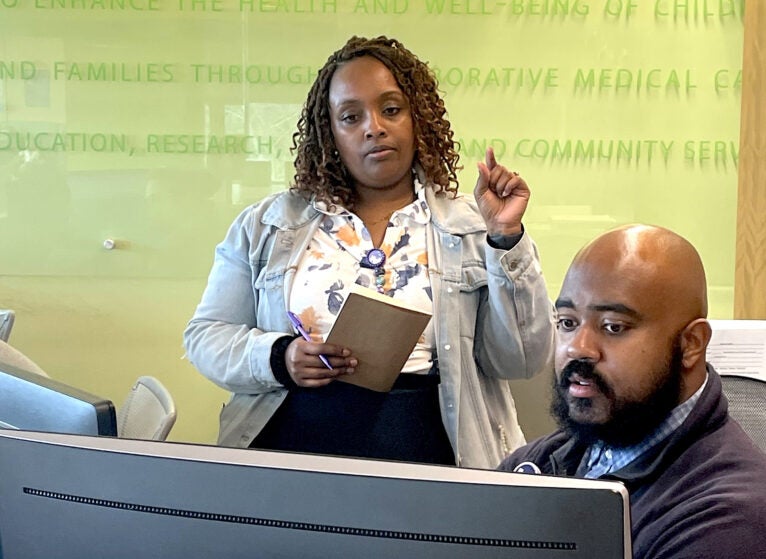
While their work is essential, this team of approximately 584 IT professionals has often operated behind the scenes. Rounding is one way to get HIT staff out onto the care units and into the offices of the customers they serve. While some HIT teams, including nurse informaticists, have been rounding regularly for years, now this practice has been adopted universally across the department.
“We need to hear what is working, where people are struggling, and where technology may actually be getting in their way. Sometimes those are things we simply won’t see from a ticket, a dashboard, or a project,” says Sapra.
HIT staff support thousands of customers across multiple locations, so the scope of this broader rounding effort is significant. Since May, many HIT teams — including HIT leaders, training professionals, desktop services members, and others — have begun rounding regularly throughout the health system. Chief Nursing Information Officer Michelle Lardner, DNP, RN, NI-BC, says that her small, four-person team alone will log around 600 hours of rounding this year.
Each team has established its own process for incorporating rounding into their day-to-day operations, from scheduling visits to reporting outcomes. But all share the same motivation and the same playbook for top-notch customer service. According to Chief Technology Officer Zeb Elliott, a successful rounding visit begins with “open ears and an open mind.”
“We want to listen and learn how we can provide a better service to affect better clinical care across our organization,” he says.
By engaging directly with teams across the organization, HIT gains a broader understanding of how work gets done and how technology can help. As Sapra explains, “When our HIT teams understand what is happening at the bedside, in the clinic, at registration, in scheduling, or throughout the patient journey, we make better technology decisions. We begin to understand not just whether a system technically works, but whether it works for the people who depend on it.”
Armed with firsthand knowledge of the customer experience, HIT team members are better equipped to respond to barriers that may inhibit workflows and patient care. Sometimes, a resolution can be accomplished on-the-spot with what Jose Rodriguez, Director of HIT Training, calls “at-the-elbow support.”
“Rounding is very interactive,” he says. “Trainers are actually sitting down with people and walking them through different processes and workflow efficiencies. It’s not us doing it — it’s the clinician — so they’re getting a more hands-on experience.”
Not every IT issue can be resolved immediately. But rounding is already creating new opportunities to identify and address problems in real time.
“In the first couple months of rounding, we had around 6% of tickets come in from rounding,” says Dotson. “That’s about 200 tickets — 200 opportunities to address the technology problems before they end up having to be reported, 200 times that a nurse or clinician did not have to contact the [help] line, and 200 instances where we made a direct impact on our clinicians' lives, hopefully saving the organization money and effort.”
“Sonney calls these issues ‘pebbles in the shoe,’” adds Kate Bakich, MS, MIT, Deputy Chief Information Officer. “These are things that bug you, but you’re not going to call the service desk to ask for help with them.”
By making themselves available and empowering staff to voice their concerns during rounding visits, the HIT team can address these “pebbles in the shoe” before they become boulders that impede workflows and jeopardize patient care. “This is a change in the way we deliver service and a change in the way the organization perceives HIT as a partner,” says Elliott. “We’re now acting proactively, fixing things before they become a bigger problem.”
According to Sapra, “the best ideas come from being close to the work.” Proximity fosters connection and collaboration, fuels insight and understanding. Already, the HIT team has implemented a variety of solutions that may not have come about if they hadn’t been present when and where the work happens.
The computer mounts on 5 West are no longer askew. A nurse knows how to change her password and can help others do the same. New hires are cruising through Epic workflows, and a team in Culpeper can continue accessing essential spreadsheets. That’s just a small sample of some of the technology barriers HIT has helped teams overcome since rounding began. But there are many more in the works, including improving cellular service throughout UVA Health University Medical Center and fixing the nurse call system in the Emergency Department. (We’ll be sharing these and other HIT rounding success stories in the months ahead, so keep an eye out for updates in Connect.)
These early wins are a testament to the success of HIT rounding. But the goal of this initiative is much greater, according to Sapra. He sees a comprehensive rounding effort as a cultural shift for HIT. A culture defined by visibility, connection, curiosity, and accountability.
“We want to be viewed as a strategic partner rather than simply a technology provider,” he says. “Rounding builds relationships. Relationships build trust. Trust creates better conversations. Better conversations uncover the right problems. And solving the right problems allows technology to better support our clinicians, staff, and ultimately, our patients.”