5.15.2026
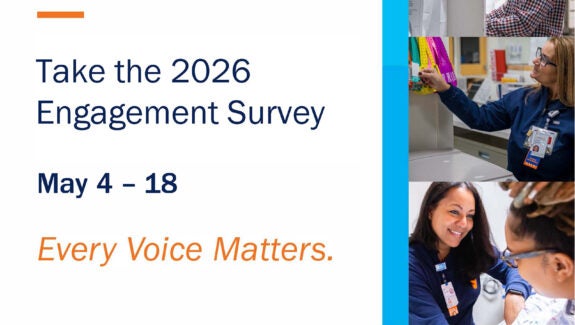
Take the Survey Today: 2026 Engagement Survey May 4-18
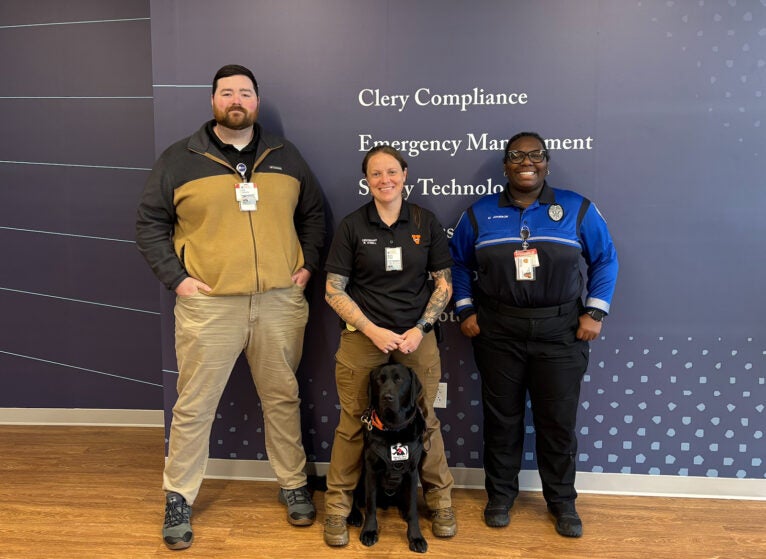
From left: Lt. Colin Clements, Lt. Maeve O'Neill, Woody, and Ofc. Mia Johnson, UVA Police Division.
It started with a phone call: Lt. Colin Q. Clements, Director of Security, UVA Police Division, reported a masked woman carrying a baby in a child safety seat on 8 East, a Labor and Delivery floor. Seconds later, an alert goes out across the hospital for a suspected infant abduction.
Most people who hear the alert over the loudspeakers do not know it's actually a child abduction drill. Or that Ofc. Mia Johnson, Security Officer, UVA Police Division — who regularly patrols the University and nearby neighborhoods — is playing the role of abductor.
Johnson, who began her UVA career at age 18 on the Welcome Team before moving to security, was familiar with the drills but unsure how this one would play out. Carrying a donated car seat with a doll covered by a blanket, she entered through the back stairwell with a simple mission to reach the hospital's front entrance.
A Successful Hospital-Wide Test of the System
UVA Health University Medical Center nurses, recognizing the threat, act quickly: forming a human barrier, questioning Johnson, verifying patient information, and running interference until security arrives.
“Staff responded beautifully,” reports Clements, who started out as a Health Unit Coordinator (HUC) in 2016 and has been in his current role since 2024. This drill is the first one he's led. “Our role player only makes it 10 steps towards the nurse's station and there are already eight people asking her why she's there. She didn’t make it off the unit!”
Team members regularly participate in unannounced, realistic, child abduction drills in areas most vulnerable to infant abduction such as maternity wards, neonatal intensive care units, and pediatric floors. “We have significant security measures in place to prevent child abduction, which include drills that keep our team members on their toes and really keep them engaged with role playing,” Clements says. “We are aiming to do two collections of drills annually — one in the spring and one in the fall.” Each collection includes several drills at different locations such as the Battle Building and Orthopedic Center Ivy Road (OCIR).
In his planning, Clements was careful to let only a select group of people know the alert was a drill: 911 Center; his counterpart, Lt. Maeve O'Neill, University Medical Center Safety and Support Unit, UVA Police Division, and the security supervisor for the day. “We want this to be as real of a stress test as possible,” he explains. “I want to see the surprise on my people's faces when they respond to the unit.”
As soon as the drill is complete, Clements sends a cancellation notification that explains that the child abduction alert is a drill.
Why Child Abduction Drills Matter
Child abduction drills aim to test not only the reaction of UVA Health team members, but also security and communication workflows, Rave System, technology, and equipment. “They are designed as a system-wide test of response,” says Clements, who was very pleased with the Call Center’s performance. “I wasn't even off the phone with them when my radio started going off. I give Contact Center Manager Patty Frye’s team a lot of credit for their response. It's very, very rapid.”
Clements' post-drill assessment report will identify any opportunities for improvement and planning another drill. “I really enjoy figuring out how we can better secure not just our physical assets, but also our patients’ and team members’ safety," he says. Past drills have identified specific needs such as adjusting the volume of announcements and streamlining communication among departments.
Johnson already has agreed to help out again in the future. “Everyone's role is important in these drills: security, nursing team members, and patients,” she says. “These drills matter so much because they remind everyone just how seriously the hospital takes infant safety. That doll represents someone's baby.”
Clements encourages staff to always take child abduction drills seriously. “Even if you think it's a drill, it will always come across as a real page, so your response should be as real as it possibly can — no matter what,” he says. “The families that bring their children here for medical care are not just entrusting us with the medical care portion of their stay, but also, their overall safety.”