10.19.2026
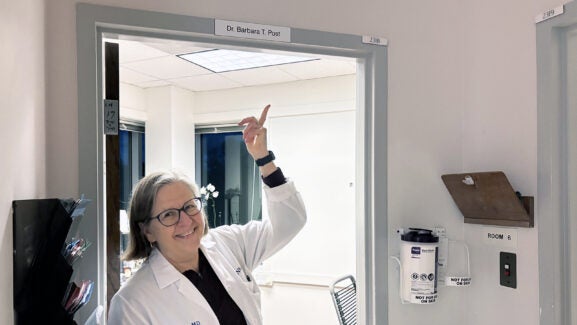
‘Feels Like Family’: Barbara Post, MD, FACP, Reflects on Nearly Four Decades of Providing Hope at Work at UVA Health Northridge Internal Medicine

An analysis of more than 1,600 cases of purported reincarnation has revealed a striking correlation: The time between death and “rebirth” was shorter on average when records indicated the prior person had died unexpectedly.
Further, the correlation was strongest among families that did not believe in reincarnation, defying researchers’ expectations.
“There had been an earlier published report suggesting a relationship between violent death and a shorter time between death and birth,” says lead author Saeedeh Sadeghi, PhD, UVA School of Medicine Division of Perceptual Studies. “We wanted to test that relationship more systematically and see whether it could be explained by cultural or psychological influences. To our surprise, the relationship was still there when we tested it in a much larger number of cases, and the social and psychological factors we examined did not explain it away.”
Scrutinizing Past-Life Reports
For their analysis, researchers reviewed 1,678 of the strongest reincarnation reports the Division of Perceptual Studies has collected over the decades. In these cases, UVA researchers have been able to match purported recollections of a previous life — usually from a child — to the experiences of a specific deceased person.
The researchers looked at variables including whether the death was natural, such as from illness or old age, or unnatural — such as from an accident, intentional violence, or suicide. They also looked at age at death and how expected or unexpected the death was.
The scientists found median intermission between death and purported rebirth was 16 months. But there was a robust association between unexpected deaths and speedier intermissions, the researchers report. The most unexpected cases averaged a 40% decrease in turnaround time. “This is the largest systematic study to date of temporal patterns in reported past-life memories. Individual cases can leave room for different interpretations, but patterns across many cases are much harder to explain as exaggeration, fantasy or fabrication,” Sadeghi says.
This temporal association persisted across multiple analyses as the researchers ruled out sources of potential bias such as the possibility of “memory contamination” — that children were repeating stories they had heard elsewhere — or that families within religions that embrace reincarnation could be using the possibility of rebirth as a coping mechanism for grief after the loss of a loved one.
One particularly surprising finding was that the association proved stronger among families that did not believe in reincarnation than in families that did.
“The effect remained even after we accounted for several cultural and psychological factors, and it was actually stronger in families whose religions did not support reincarnation,” says UVA researcher Philip Cozzolino, PhD. “These results do not support the idea that social beliefs are driving this pattern.”
In a new scientific paper outlining the findings, the research team notes the results align with prior studies in this area. The mounting evidence, they write, suggests the intermission pattern “may reflect a systematic phenomenon not readily accounted for by existing psychosocial frameworks.”
That’s not to say the researchers have concluded that reincarnation is real. But further study, they argue, is warranted.
“We hope this work encourages researchers to look beyond individual cases and ask whether there are broader patterns that can be tested systematically,” says UVA’s Marieta Pehlivanova, PhD. “The mechanisms underlying these findings are currently unclear, but that gives us even more reason to keep looking, not to look away.”
Findings Published
The researchers have published their findings in the American Psychological Association journal Psychology of Consciousness: Theory, Research and Practice. The research team consisted of Sadeghi, Pehlivanova, and Cozzolino. The researchers have no financial interest in the work.
The research was supported by TMT Foundation, The Philip B. Rothenberg Legacy Fund, BIAL Foundation, and The Dreamery Foundation.
About UVA Division of Perceptual Studies
Established in 1967 under the leadership of UVA psychiatrist Ian Stevenson, MD, UVA Division of Perceptual Studies (DOPS) stands as the most productive university-based research group in the world dedicated to exploring phenomena that challenge conventional scientific paradigms concerning human consciousness.
At the core of DOPS’ research mission lies the commitment to rigorous evaluation of empirical evidence surrounding exceptional human experiences and capacities, including utilization of a state-of-the-art neuroimaging lab. DOPS extends its focus beyond fundamental empirical research and explores the profound implications of such research for scientific theory and society at large. By actively sharing insights and findings, DOPS strives to contribute meaningfully to the understanding of consciousness, bridging the gap between scientific inquiry and public awareness.
To keep up with the latest medical research news from UVA and the Manning Institute — bookmark the Making of Medicine blog.


Outstanding. We need more studies on phenomenon like this and others such as Dr. Greyson’s studies on NDEs.