8.25.2026
Forbes Ranks UVA Health Among Best Employers for Women
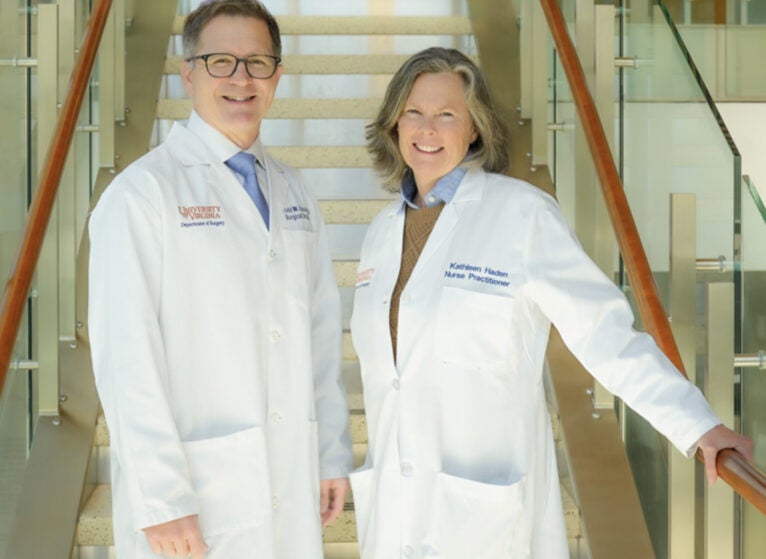
From left: UVA Health's Todd Bauer, MD, and Kathleen Haden, RN.
Early detection of pancreatic cancer saves lives. Linda Groves, MSN, ANP, of Charlottesville, Virginia, is living proof. When Todd Bauer, MD, Chief of Surgical Oncology, diagnosed Groves in November 2022, her cancer was stage II, which is relatively early and associated with better outcomes. According to the Pancreatic Cancer Action Network, most patients aren’t diagnosed until stage IV, when the disease is so advanced that it’s hard to treat and survival rates are low.
Now cancer-free, Groves is giving back to UVA Comprehensive Cancer Center as a donor and volunteer member of the center’s advisory board. She recently made a gift to support UVA’s participation in a collaborative global research project called the Pancreatic Cancer Early Detection (PRECEDE) Consortium, which has the ambitious goal of increasing the five-year survival rate for pancreatic cancer from 10% to 50% within the next ten years.
As one of 65 academic institutions participating in the PRECEDE Consortium, UVA Comprehensive Cancer Center is helping to gather and analyze data and samples from thousands of patients at high risk of developing pancreatic cancer. The hope is that researchers worldwide can use this information to identify new biomarkers indicative of disease risk and occurrence, launch clinical trials of new screening techniques and treatment targets, and test new prevention methods.
Spotting a ‘Silent’ Killer

Pancreatic cancer is often called the silent disease because it can grow unnoticed for years. Most patients don’t experience symptoms until the cancer has metastasized and their prognosis is poor. Despite affecting a relatively small percentage of Americans, pancreatic cancer is now the third leading cause of cancer deaths in the United States.
But hope lies in the discovery of earlier detection methods.
“When pancreatic cancer is found early, survival improves dramatically,” says Kathleen Haden, RN, MSN, ANP-C, who co-founded UVA Health’s High-Risk Pancreatic Cancer Screening Clinic together with Dr. Bauer. Established in 2013, this clinic was the first in Virginia and among the first of its kind in the nation. Under the direction of Dr. Bauer, it has screened more than 1,500 high-risk individuals — helping them access advanced imaging, genetic testing, and ongoing surveillance to identify cancer before symptoms appear.
A 2024 study incorporating Dr. Bauer’s research found that nearly 78% of pancreatic cancer patients screened and treated at high-risk clinics like UVA Health’s experienced a five-year survival rate, compared to roughly 13% of patients in traditional surgical oncology clinics.
Now, through the PRECEDE Consortium, UVA is helping to further improve prognoses and outcomes for those at risk of developing one of the deadliest human diseases. “PRECEDE is the definition of knowledge is power,” explains Dr. Bauer. “You have to build knowledge to find the next steps.”
“What makes PRECEDE so powerful is its global collaboration,” shares Margaret A. Caspler, President and CEO, PRECEDE Foundation — the nonprofit supporting the consortium’s efforts. “Progress against pancreatic cancer will only happen through coordinated international effort, and UVA is playing a critical role in that mission."
Already, UVA has enrolled 170 patients in the PRECEDE study. “Our high-risk clinic and participation in PRECEDE merge our work advancing science and delivering world-class care,” says Dr. Bauer.
The PRECEDE Foundation offsets some of the costs incurred by participating institutions and provides research assistance and other resources; however, philanthropic support from local community members, like Groves, enhances UVA’s ability to enroll additional patients and conduct other groundbreaking pancreatic cancer research. “I was diagnosed early, and I’m back to my very active lifestyle. Supporting this growing and successful program is very important to me."