4.16.2026
‘A Moment of Love and Hope’
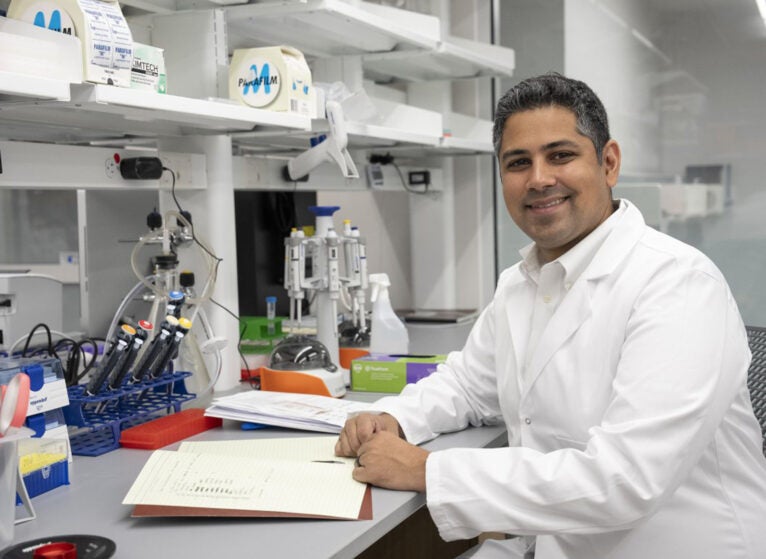
Sameer Bajikar, PhD (Photo by Dan Addison)
When Sameer Bajikar, PhD, accepted a position as an assistant professor in the Departments of Cell Biology and Biomedical Engineering in January 2024, it was both a homecoming and the official start of his career as an independent research scientist. The proud double Hoo earned his bachelor’s and graduate degrees at UVA before completing a postdoctoral fellowship at another institution.
Without a critical combination of competitive public grants and private support, Bajikar could not have completed his training or launched his independent research laboratory at UVA — a milestone in the career of an academic scientist. Today, he’s investigating the biological roots of childhood neurodevelopmental disorders such as autism and Rett syndrome. His ultimate goal is to engineer new treatments targeting these biological pathways. Bajikar is also paying it forward by training the next generation of aspiring scientists who may one day carry his discoveries even further.
“Until starting in January 2024, I was working under a mentor, who supervised and guided my research directions. Now, I am that mentor to the individuals in my lab,” said Bajikar.
Working in his lab today are three graduate students, four undergraduate researchers, and a few prospective undergraduate volunteers. These mentees assist with the laboratory’s day-to-day work, run experiments, and collect and analyze data, all while learning valuable research skills and cultivating their own scientific interests.
Launching an independent academic research program of this scope requires not only vision and expertise but also robust financial support at every stage of career development. For example, to complete his PhD in biomedical engineering at UVA, Bajikar relied on three funding awards: a Commonwealth Fellowship, UVA’s Sture G. Olsson Fellowship, and a National Science Foundation Graduate Research Fellowship. His postdoctoral fellowship at Baylor College of Medicine was supported by the National Institutes of Health and a prestigious award from the Jan and Dan Duncan Neurological Research Institute at Texas Children’s Hospital.

At that point, Bajikar faced a precarious stage in the career of an emerging academic scientist: the transition from training in someone else’s lab to launching your own. It’s a risky, expensive venture requiring the support of a special kind of funder who believes in your potential and understands the importance of investing in early-career scientists.
For Bajikar, that funder was the International Rett Syndrome Foundation, a leading nonprofit organization dedicated to accelerating research, providing patient and family support, and advancing treatments for the rare genetic neurodevelopmental disorder.
“This kind of funding is absolutely essential at the early stage,” Bajikar explained. “Research projects are multiyear endeavors, and early-career scientists are still building their reputation and track record. Without initial support, it can become a circular struggle — needing data to secure grants but needing grants to generate that data.”
The foundation’s support has already made a tangible difference. It has allowed Bajikar to establish his lab at UVA, pursue high-risk, high-reward ideas, and begin generating the preliminary data needed to compete for larger federal grants to sustain his lab for years to come. Most importantly, it has provided the stability required to ask ambitious scientific questions that could ultimately change how neurodevelopmental disorders are understood and addressed.
As Bajikar explained in this Research in Motion video from UVA School of Medicine, children with autism spectrum disorder and other neurodevelopmental challenges have very few treatment options available to them today. Thanks to the early research funding he’s received, Bajikar and his team are well on their way to developing solutions that can improve children’s lives in the future.