
8.26.2026video
UVA Health Update | Aug. 26, 2026
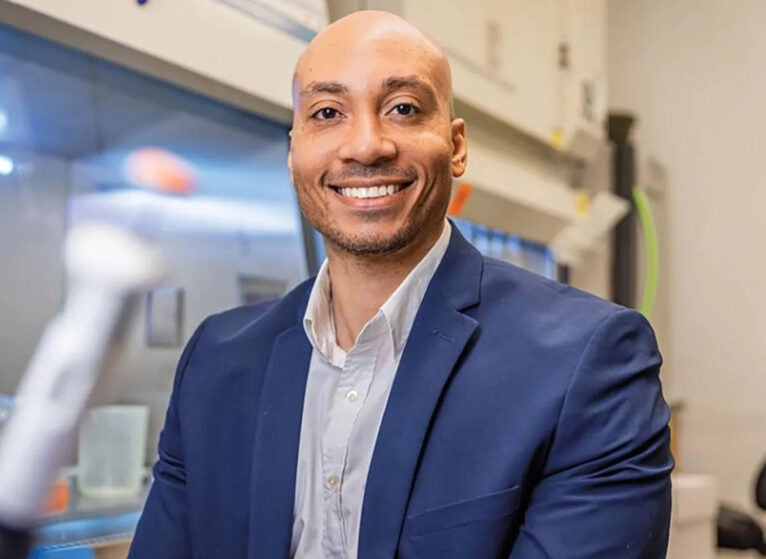
A UVA scientist and colleagues have used cutting-edge nanotechnology to obtain important new insights into sight-stealing glaucoma and provide researchers a much-needed new tool in their search for a cure.
Nanotech expert Evan Scott, PhD, Director, UVA Institute for Nanoscale Scientific and Technological Advanced Research, and collaborators deployed astonishingly small “nanocarriers” to probe a tiny vessel that is responsible for draining fluid in the eye. Deficiency in the drainage of this fluid, called aqueous humor, causes harmful pressure increases inside the eye and is associated with vision loss.
Doctors often seek to reduce eye pressure to preserve glaucoma patients’ sight, but not all patients respond to or comply with their treatment, which typically involves daily eye drops. Scott’s new findings help scientists understand key mechanisms behind fluid drainage and what can go wrong. This nanotech work has allowed the research team to develop the first genetic mouse model with sustained “intraocular” pressure, allowing scientists to more easily study and hopefully treat glaucoma.
“Primary open-angle glaucoma is an incurable, progressive disease that is the leading cause of irreversible blindness worldwide,” says Scott, UVA Department of Biomedical Engineering, a joint program of UVA School of Medicine and UVA School of Engineering. “Although we know that glaucoma is associated with high intraocular pressure, usually referred to as IOP, studying this process has been challenging due to a lack of relevant disease models. Our nanocarriers allow us to selectively probe specific cells in the eye to both better understand how IOP can increase and, importantly, identify new therapeutic targets for gene therapy that could one day cure glaucoma.”
Understanding Glaucoma
Glaucoma is a leading cause of vision loss, affecting 64 million people worldwide and blinding more than 3.5 million. Intraocular pressure is the only modifiable risk factor for the most common form of the disease. Patients are commonly prescribed eye drops to reduce this pressure and improve fluid drainage, but more than 50% are noncompliant with or discontinue their topical therapy within the first year because of inconvenience and side effects. This compliance gap is a major cause of preventable vision loss in glaucoma, so researchers continue to seek new therapies for permanent IOP reduction with minimal adverse effects.
Part of the challenge in developing new treatments is that researchers have lacked effective ways to study the site of fluid drainage in the eye, known as the Schlemm’s canal. Scott and his collaborators used nanocarriers to deliver a drug, tamoxifen, directly to the cells lining the canal’s walls to modify the expression of a gene called Prox1. This allowed them to simulate problems with the drain in lab mice so they could better understand what was happening.
The results were striking: Intraocular pressure shot up within four weeks and stayed that way permanently. The canal also stopped functioning correctly, becoming stiffer and less permeable.
The findings suggest that scientists may be able to use targeted nanotechnology and gene therapy to address the faulty canal walls and restore their proper function. But while that lead is promising, the creation of a way for scientists to study the canal’s workings may prove equally or even more important.
“Our nanocarrier-based method identified Prox1 as a new genetic target within the Schlemm’s canal that can modify IOP. We’re now focused on developing a gene therapy that could permanently decrease IOP after a single administration and without daily eye drops or surgery,” says Scott, Thomas A. Saunders III Family Jefferson Scholars Foundation Distinguished University Professor at UVA. “This work not only shows the promise of gene therapy in the treatment of glaucoma but also highlights how nanotechnology can be employed both as a tool to understand disease as well as a means for therapeutic intervention.”
Nanotechnology is a major focus area for UVA Paul and Diane Manning Institute of Biotechnology. The institute brings together top experts across the university and beyond to accelerate the development of new drugs and cures for complex diseases, to benefit patients across Virginia and around the world.
Findings Published
Scott and his collaborators have published their findings in the scientific journal JCI Insight. The paper is open access and free to read. The research team consisted of Sofia Lara Ochoa, Hoi-Lam Li, Hyeohn Kim, Zihang Yan, Natalia C. Mendonca, Pan Liu, Hyunjoo J. Lee, Michael P. Vincent, Sultan Almunif, Hao F. Zhang, Haiyan Gong, Scott, Mark Johnson and Benjamin R. Thomson.
Scott and members of the research team have submitted patents related to the work. A full list of the authors’ disclosures is included in the paper.
To keep up with the latest medical research news from UVA and the Manning Institute, bookmark the Making of Medicine blog.